
Statement on the Sentencing of Jimmy Lai and Co-Defendants
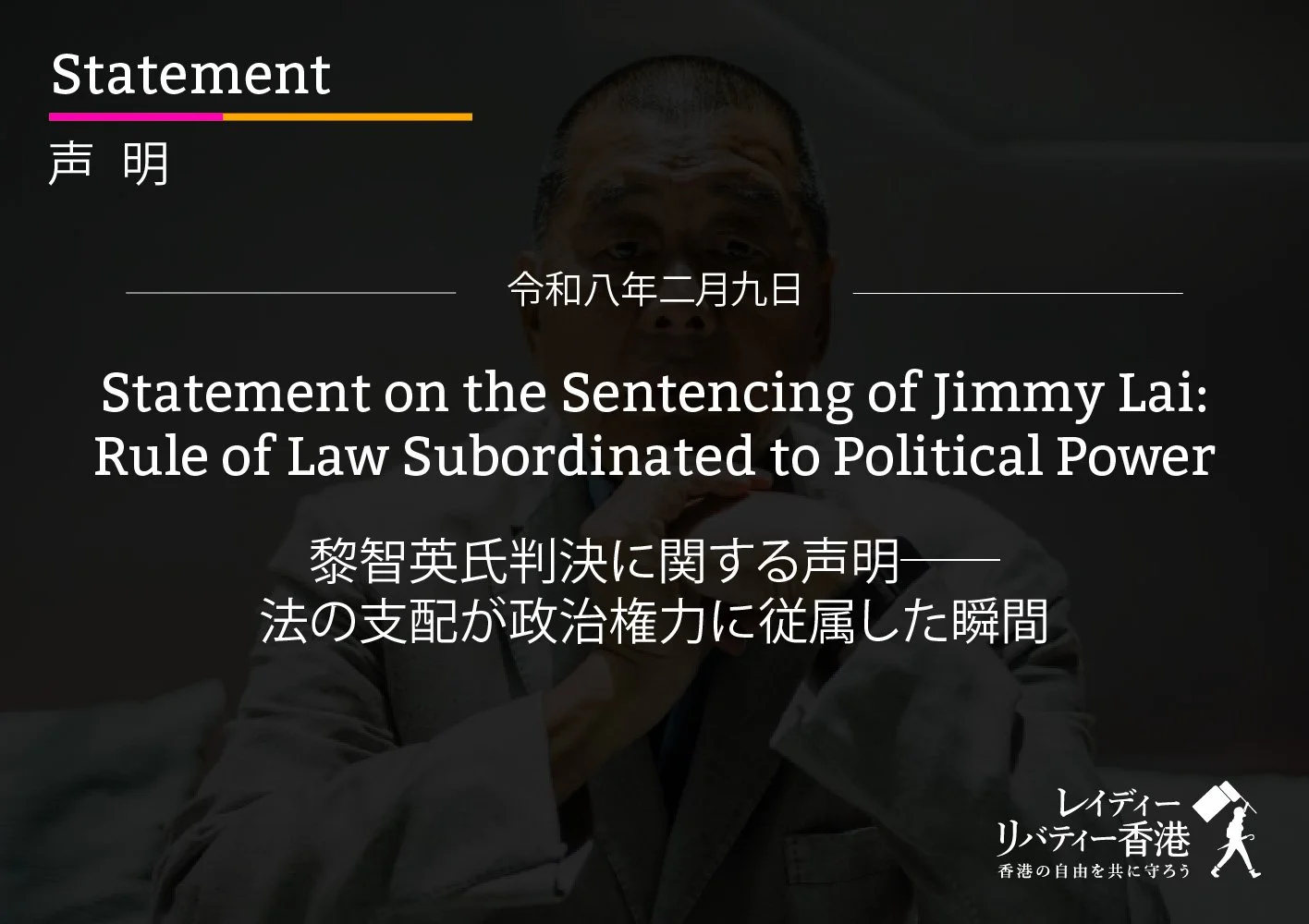
Statement on the Sentencing of Jimmy Lai: Rule of Law Subordinated to Political Power
2026/2/9 – For Immediate Release
Today, the 20-year sentence imposed on Jimmy Lai—amounting in practice to a de facto life sentence for a 78-year-old man—together with the heavy prison terms handed down to his co-defendants, marks a grave escalation in the use of Hong Kong’s National Security Law as an instrument of political repression.
1. On the Hong Kong Judiciary
We condemn the Hong Kong court for willingly bending the rule of law to conform to Beijing’s political narrative, despite the clear absence of substantive, credible evidence that would meet international standards for criminal conviction. By designating Jimmy Lai as the “mastermind” of foreign collusion and imposing the harshest sentence under the National Security Law to date, the court has abandoned judicial independence and transformed itself into an enforcement arm of political power.
This ruling confirms that Hong Kong’s courts no longer function as impartial arbiters of law in national security cases. Instead, they provide a procedural façade to legitimize outcomes that are political in nature.
2. On Beijing’s Responsibility
We condemn the Chinese government for weaponizing the National Security Law and the prosecution of Jimmy Lai to consolidate domestic power and entrench a model of governance based on coercion and deterrence. The Lai case was never about genuine national security concerns. It was about eliminating a symbolic figure of dissent and demonstrating that resistance—real or perceived—will be met with total incapacitation.
This strategy does not end in Hong Kong. Allowing the persecution of domestic dissent to proceed unchecked strengthens personalist rule, removes internal constraints, and lowers the political cost of external aggression. An unchallenged Chinese Communist Party is not made more stable by repression; it is emboldened. The consequences extend beyond Hong Kong, contributing directly to heightened risks across the Taiwan Strait and the broader Indo-Pacific region.
3. A Call to Western Governments
We urge Western governments to fundamentally realign their approach. The sentencing of Jimmy Lai demonstrates that moral condemnation and human-rights rhetoric alone are insufficient when confronting a system that frames repression as regime survival.
Humanitarian outcomes will only be achievable if governments move beyond symbolic pressure and begin bargaining for concrete results through a new architecture—one that integrates human-rights demands into trade, supply-chain, financial, and strategic negotiations. This must include sustained efforts to pursue sentence and serving-time engineering for Jimmy Lai and other political prisoners, through mechanisms that reduce political risk while delivering measurable humanitarian relief.
「The de facto lifetime sentence imposed on Jimmy Lai is also a death sentence to the West’s strategy of human-rights petitioning. We cannot exchange human rights for economic and geopolitical stability. When repression is tolerated in the name of pragmatism, it does not produce stability—it accelerates authoritarian consolidation and regional instability.」
The choice facing democratic governments is no longer between values and pragmatism. It is between ineffective outrage and outcome-oriented statecraft. Continued inaction will not preserve stability; it will reinforce the very forces that threaten it.
Lady Liberty Hong Kong︱レイディー・リバティー香港
Tokyo, Japan︱日本東京都
