
Chow Hang-tung's Closing Submissions (Oral)
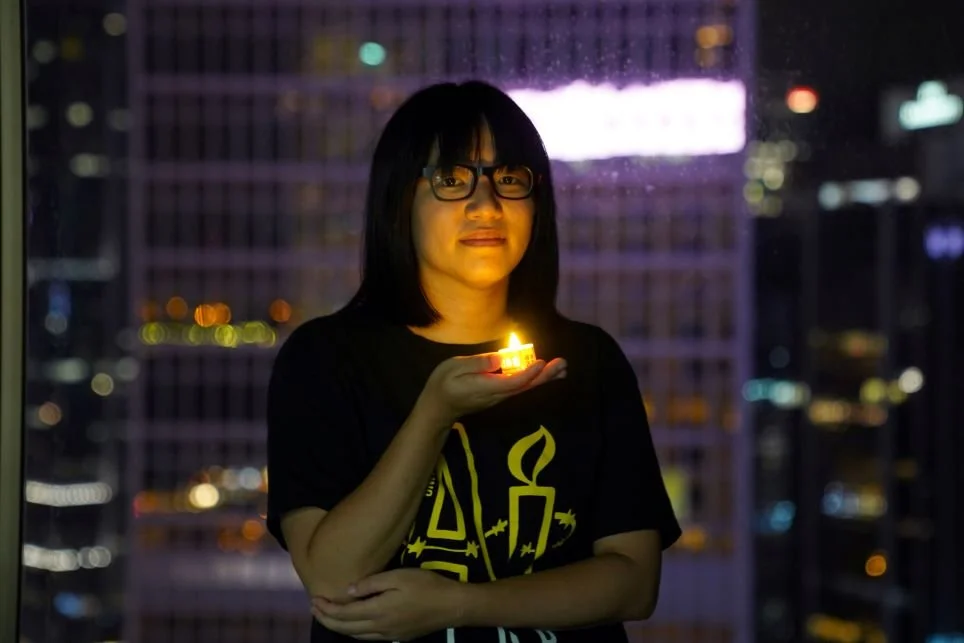
Chow Hang-tung’s Closing Submissions (Oral) — HCCC 155/2022
Editor’s note: On 19 May 2026, barrister and former Hong Kong Alliance vice-chair Chow Hang-tung delivered her oral closing submissions in the Hong Kong court, in the case arising from the Alliance’s role in organising the annual June Fourth vigil. Speaking in her own defence, she dismantles the prosecution’s theory point by point — asking what the law truly seeks to prohibit, and what a constitution is for. Her argument is that “ending one-party dictatorship” is not a crime but a call for the rule of law, and that what is really on trial is not the defendant but the law itself. We reproduce her submissions in full so that her words may reach beyond the courtroom.
In brief
Chow Hang-tung’s defence is unusual: rather than deny what she did, she embraces it. Her submission argues that the phrase at the centre of the case — “ending one-party dictatorship” — is not a call to subvert the state but a call for the rule of law itself, the very thing a constitution exists to protect. She draws a sharp line between “ending” something and “overthrowing” or “destroying” it, and points out that the prosecution never identified a single unlawful act, nor named any “unlawful means” the Alliance ever used in over thirty years. She also exposes a contradiction at the core of the case: ordinary citizens are accused of breaching a Constitution that, by the prosecution’s own logic, only the state can breach. Her conclusion is that what is truly on trial is not the defendant, but whether Hong Kong’s law will still defend democracy and human rights — or become “a watchdog for dictatorship.”
Chow’s words speak directly to why we remember. Lady Liberty Hong Kong is presenting Hong Kong, June Fourth, and National Security — When Memory Is Put on Trial, a commemorative exhibition marking the 37th anniversary of the June Fourth crackdown, at the Scott Hall Gallery, Waseda Hoshien, Tokyo, from 27 May to 7 June 2026. Learn more about the exhibition →
I. Introduction
1. As a criminal case, this is indeed a weird one. The defence has made no dispute over what happened and has even proactively put forward a great deal of additional evidence as to what the defendant actually did. The defendant never denied any of our actions, nor have we ever claimed that what we said reflected not our true thoughts or was merely some kind of exaggerated rhetoric. We even explicitly stated that we never just talked the talk; we did put our words and our operational goals into practice.
2. Common defence strategies in criminal cases, such as downplaying the alleged conduct and distancing oneself from the events, were entirely absent in this case. Quite the opposite, the defendant embraced the conduct the prosecution labelled as criminal, to the extent that even when the court (and the prosecution) used wordings that sounded more radical, the defendant had no qualms about them. For insofar as the substance is there, the choice of words is simply a peripheral detail.
3. The court can see that the crux of contention in this case is not what the defendant did or was thinking, but what the law seeks to prohibit and what it seeks to protect. And to answer this question, we cannot stop at a superficial comparison of wordings but must instead ask what system the defendant was seeking to end, and what system the Constitution was to establish.
4. The real core issue is whether the law truly forbids us from pursuing a democratic transition and defends the Communist Party’s perpetual rule. In the face of the government’s abuse of power and arbitrary killings, does the law only allow us to swallow and wallow in our discontent but not to demand an end to such a tyranny?
II. The meaning of Ending One-Party Dictatorship
5. After all, the goal for ‘ending one-party dictatorship’ is to end the state of unchecked power. This is the most important reason for the rule of law to exist, and this is also the obligation that every court in the world should observe. It is impossible for a court to criminalise such a phrase and at the same time claim itself a guardian of the rule of law.
6. The court could, of course, argue that when the defendant uttered the words ‘ending one-party dictatorship’, they weren’t referring to ending one-party dictatorship but to something that was entirely unrelated to those words. Leaving aside whether there’s any evidence for that, the point is the court cannot rule that the phrase itself is unlawful or implies subversion without simultaneously negating its own mandate.
7. The court must recognise that the key word in that phrase – dictatorship – is not a hollow sign or a term invented simply to provoke emotion. It has its own substance. To avoid confronting the meaning of ‘dictatorship’ and ‘ending one-party dictatorship’. To treat them merely as the markers of a crime while declaring this rule-of-law objective off limits would amount to self-defeat and would only reinforce the claim that Hong Kong’s rule of law is already dead.
III. The Nature of the Constitution
8. The court must address not only the meaning of ‘ending one-party dictatorship’, but also the true nature of the Constitutional order before deciding whether the two are genuinely in conflict. More than the defendant’s purpose, it is the Constitution’s own meaning that has remained the most uncertain, least supported, and least consensual issue in this case.
9. The purpose of a document that can be properly called a constitution is to regulate the exercise of public power, prevent it from harming ordinary people, and not to constrain them. In other words, a constitution is a tool developed by human society to end all forms of despotism.
10. If ending dictatorship is the very purpose of a constitution, how can it be spun to become unconstitutional if not by arguing that China’s Constitution is not a proper constitution, but a sham that serves dictatorship? And this will explain why it not only fails to limit the Communist Party’s power but instead entrenches its perpetual rule and can even be used to forbid citizens from challenging illegitimate authority, rather than protecting them from abusive power.
11. The above is substantially the prosecution’s argument and the basis for this prosecution. Put simply, the prosecution argues that the system established by the Constitution is not constitutionalism or the rule of law, but one in which the Communist Party monopolises power and directs everything, that is to say, a textbook one-party dictatorship. Even if the prosecution avoid using that term does not alter the substance of its argument.
12. This brings us to the second oddity in this case. The prosecution says we are wrong to call China a one-party dictatorship; it however argues repeatedly that the Constitution establishes exactly that. Throughout the trial, it has been the prosecution, not the defence, that has denigrated the Constitution by insisting it necessarily mandates one-party dictatorship. By contrast, the defence has persistently informed the court that this is not the Constitution’s only possible reading. In fact, the court can interpret the Constitution in a way that accords with the principles of the rule of law and democracy, rather than unduly rendering it into a bizarre monstrosity that completely in breach of the constitutional principles.
13. After all, how much basis does the prosecution have for saying that the Constitution is the interpretation that gave the Communist Party supreme power? It relies almost entirely on a single sentence added into the Constitution just a few years back: ‘The leadership of the Communist Party of China is the defining feature of socialism with Chinese characteristics’. But does that sentence explain what ‘leadership’ means? It does not. Does any provision of the Constitution define the scope of that leadership, what the Party may decide, what it may not interfere with, or the procedures for exercising such power? No. None at all. Throughout the entire Constitution, the only description of the Communist Party’s powers—or possible powers—is the single word ‘leadership’.
14. ‘Leadership’ has never been synonymous with real power or the right to govern. Charles III, for example, is the head of state for the United Kingdom, yet he holds no substantial political power. On what basis, then, can the prosecution argue that the mere word ‘leadership’ in the Constitution gives the Communist Party carte blanche to rule the entire country, override every state organ established by the Constitution, and remain perpetually unaccountable to the people?
15. For example, the Constitution expressly provides that the President of the State is elected by the NPC (Article 62). But if the Communist Party has pre-determined the outcome backstage before it ‘leads’ the NPC to conduct the election, then it is the Communist Party, not the NPC, who is in the driver’s seat for the election. In fact, the NPC also has the power to remove the President from office (Article 63). But if the NPC is subject to Party leadership and cannot act without Party consent, then that constitutional power of removal is nothing but a dead letter.
16. And the problem is not confined to the NPC. It implicates all constitutional organs. The Constitution expressly states that the people’s courts (Article 131) and the people’s procuratorates (Article 136) exercise judicial and prosecutorial power independently. But if decisions about whom to prosecute and how to judge are ultimately dictated by the Party, then what is the point of talking about an independent judiciary or procuratorate?
Most dangerous of all is the principle that the Party commands the gun—that the military must take after the Party and owe loyalty to it. We have heard this constantly in official propaganda, but this directive is utterly unconstitutional. Under the Constitution, the CMC should answer to the NPC, which is elected by the people (Article 94), and owe its allegiance to the Constitution and the people, not to the Party. It is precisely because the Party has taken control of the gun and monopolised overwhelming force that the Constitution with the law stripped of any real power and reduced to mere window dressing.
17. Therefore, the prosecution’s assertion that sees ‘leadership’ as control over everything has no basis in the constitutional order. It is rather contradicting the stipulations of the Constitution. To perceive the Constitution as a shield for arbitrary power rather than a limit on it truly subverts its nature and purpose.
18. In fact, the prosecution’s claim that the Party’s leadership overrides everything is not grounded in any specific constitutional provision. It just sadly reflects the country’s political reality, a reality that has existed for many years before the clause on ‘Party leadership’ was added to the Constitution. Can it therefore be argued that, when the Constitution was amended, the drafters were simply codifying the existing reality and the powers the Communist Party had already assumed? Given constitutional violation is an established fact, does that mean that such a fact should be allowed to define our law?
19. In this regard, the Korean case I referred to in my submission is directly relevant, as it is about how a court should respond when constitutional ideals diverge from the realities of political power.
The case arose from the 5.18 Gwangju Democratic Uprising, which occurred 46 years ago today. Like the Tiananmen Square protests, it involved the military killing civilians and imprisoning many others, but the killers remained in power. The difference, however, was that South Korea later underwent a democratic transition, and the perpetrators were eventually brought to justice. At the time, the defence argued that because they had seized power, rewritten the constitution, and governed under the new constitutional order, their authority must necessarily be constitutional. How, then, could they be accused of subverting the constitution? The Supreme Court rejected that argument. It held that, whatever amendments may be made, a constitution remains, by its very nature, a legal order grounded in popular sovereignty, liberal democracy, human rights, and the rule of law. Such an order can never legitimise a military dictatorship established in breach of democratic procedures. In that context, it was the usurpers – those who assumed that power itself could define the law, who truly subverted the constitution, not the citizens of Gwangju, who resisted martial law and defended its spirit.
20. This judgment shows that holding power does not necessarily confer authority over the meaning of the law. If a constitution is truly to merit that name, it cannot be reduced to the victor’s arbitrary command. It must embody its own coherent and enduring principles and spirit, whether or not those principles are fully realised in practice.
21. In the context of the Chinese Constitution, the essential question is: what is its core spirit? Is it democracy and the rule of law, or dictatorship and rule by man? If it is the former, then the true subverter of the Constitution’s fundamental order is not the defendant, but the Chinese Communist Party, which has long disregarded democratic procedures, monopolised state power, and even sought to legitimise its dictatorship through constitutional amendment. Only if the court accepts the opposite – that the Chinese Constitution is, at its core, a constitution of dictatorship, and that its references to democracy and the rule of law are solely decorative, incapable of displacing the overriding principle of one-party dictatorship – would there be any basis for this case to proceed.
IV. Overthrow, Destroy
22. Even if we assume that the Constitution establishes a one-party dictatorship under the Communist Party’s perpetual rule, and hence the defendant’s objective is fundamentally inconsistent with that framework, does that mean the prosecution has already proved the case? Of course not. For what the prosecution must establish is not the conflict between two theories, but the presence of any element of ‘overthrowing or destroying’ as well as the use of ‘unlawful means’.
23. The prosecution has never explained what kind of conduct amounts to ‘overthrowing’ or ‘destroying’. Instead, it repeatedly refers to ‘ending’ and, with no justification whatsoever, treats the two as equivalent.
24. Even a cursory look at the dictionary shows that ‘ending’ is not the same as ‘overthrowing’ or ‘destroying’. A restaurant’s closure does not mean someone has overthrown or destroyed it. The owner may want to retire, the landlord may refuse to renew the lease, or the business may simply fail to keep up with the times, hence phased out. There could exist many reasons unrelated to overthrow or destruction. Likewise, if I dislike a restaurant and post a negative review, urge others not to patronise it or, even as a competitor, seek to take over its premises, they do not necessarily become acts of ‘overthrowing’ or ‘destroying’ the restaurant. Because such acts can be conducted in a reasonable, justifiable and lawful manner, they are within my rights as a customer or competitor – even if they ultimately contribute to the restaurant’s ‘closure’.
25. By contrast, if you alleged that I had hired triads to cause trouble at the door, or deliberately lied to defame others, fabricated public opinion, or bribed board members, those acts could possibly be characterised as ‘overthrowing’ or ‘destroying’.
26. But has the court seen any conduct of that kind in this case? None. On the contrary, the defendant was simply stating facts with reasoned arguments. Even the prosecution cannot deny that those statements were grounded in fact. Be that the case, then how can there be any talk of overthrowing or destroying?
V. Unlawful Means
27. The allegation of ‘unlawful means’ is more absurd. Even at the close of case, the prosecution still cannot say what this unwarranted charge of unlawful means is nor can they produce a single example. At most, it argued that the Hong Kong Alliance had ‘not referred to any lawful means, such as amending the Constitution in accordance with its provisions, for “ending one-party dictatorship”’ (§ 60(11)). It went further to claim that in this case, the evidence has ‘excluded’ any lawful means to such an end (§ 13(5)).
28. Let’s first leave aside the prosecution’s sophistry, which both reverses the burden of proof and defies logic. What if I tell a restaurant to shut down without stressing to its owner the need to follow through legal procedures, am I then inciting him for an unlawful closure? And if only the owner has the legal power to close the restaurant, does my negative review as a customer, which causes the business to fail, thereby becomes the ‘unlawful means’?
29. ‘Not calling for a constitutional amendment by lawful means’ and ‘calling for unconstitutional means to end one-party dictatorship’ are two propositions worlds apart. Neither is equivalent to any part of the other. By and large, the prosecution’s argument commits five major logical fallacies.
(1) One cannot prove what the defendant did by pointing to what he did not do. Furthermore, the prosecution has never managed to prove what the defendant had not done. The prosecution has produced no evidence to that effect.
(2) The prosecution’s identification of one lawful means does not render all other means unlawful. By putting it this way, the prosecution is to reverse the principle that ‘whatever is not prohibited is permitted’.
(3) Vaguely calling a means ‘unlawful’ does not mean it is instinctively ‘unconstitutional’. In this case, the prosecution must prove ‘unconstitutionality’ instead of simply alleging a violation of an unspecified law.
(4) The absence of a lawful means to attain a given goal does not imply the existence of an unlawful one. A more plausible conclusion instead is there is currently no means, lawful or unlawful, to that end. The prosecution has never proved the existence of any unlawful means in this world capable of ‘ending one-party dictatorship’, not even contending the theoretical probability of such an existence. By contrast, the defence has explained that ending one-party dictatorship means subjecting power to legal constraints. By definition, that can be done only through the rule of law. No unlawful means can bring it about. By far, the prosecution has not challenged this part of the testimony.
(5) In fact, the Constitutional amendment much emphasised by the prosecution will not lead to the end of one-party dictatorship. Hence, to describe it as the only ‘lawful means’ is a false premise. Did one-party dictatorship not already exist before the insertion of that clause into the Constitution? It did, of course. And will reverting the Constitution now end it? Don’t be silly. So, amending the Constitution is just like holding rallies, drafting human rights and organising forums, etc. They can at most advance that goal of ending one-party dictatorship, but none can directly achieve it. There are countless lawful ways to work toward ending one-party dictatorship, the vast majority of which cannot plausibly be called unlawful, still less ‘unconstitutional’, just like the aforementioned rallies and petitions. So even if the prosecution could exclude the constitutional amendment, it could not exclude every other lawful means. The evidence, moreover, has clearly shown that the Hong Kong Alliance did advocate a range of lawful means to end one-party dictatorship. Where’s the exclusion?
30. After all, ‘ending one-party dictatorship’ is a matter of making the law effective. It is never a goal that can be achieved simply by amending laws or the Constitution. That is why the Hong Kong Alliance never limited its demands to mere legal amendments by the government. It also called for measures to ensure the law is enforced in practice, including the establishment of oversight mechanisms, accountability, and external scrutiny. The best safeguard, of course, is having genuine, free and fair elections together with an independent and vibrant civil society. To focus on whether we called for Constitutional amendments, or whether such amendments are possible in the current prosecution, is therefore to miss the point entirely.
VI. Contravening the Constitution
31. On the element of ‘unlawful means’, as I just noted, the prosecution can’t just flippantly claim your means were unlawful. They must prove the existence of a specific ‘constitutionally unlawful means’. This also brings to light the third oddity of the case: that the entity alleged to have breached the Constitution could surprisingly be some ordinary persons.
32. The prosecution’s argument on this element is riddled with irreconcilable contradictions and paradoxes. I will focus on three points:
(1) A breach of the Constitution, particularly Article 1, cannot in principle amount to an ‘unlawful means’ under NSL22;
(2) An ordinary person cannot violate the Constitution;
(3) The prosecution’s claim that ‘any act aimed at ending one-party dictatorship must necessarily violate the Constitution’ is plainly wrong.
33. First, the prosecution’s case suffers from a basic legal flaw. The Chinese Constitution does not apply directly in full in Hong Kong. It takes effect necessarily through local legislation. I think both the prosecution and defence agree on this. This is also fundamental to ‘One Country, Two Systems’, and there should be no dispute about it.
It follows that, in Hong Kong, ‘contravening the Constitution’ alone cannot constitute a separate allegation of ‘unlawfulness’. Such an allegation can only be established indirectly through a specific Hong Kong law that is violated. But if the prosecution identifies a Hong Kong law that has allegedly been breached, citing that law as the basis for ‘unlawful means’ is sufficient. Any extra reliance on acts that ‘contravene the Constitution’ is redundant.
34. In this case, can the prosecution point to a single piece of Hong Kong legislation that gives effect to Article 1 of the Constitution? Yes, that’s NSL22.
35. It follows that on ‘unlawful means’, the prosecution’s case is the defendant is accused of violating the NSL22 by means of violating the NSL22. Such a claim is laughable on its face. In fact, the prosecution is trying to invoke some seemingly different wordings, i.e. ‘contravening the Constitution’, to disguise their circular reasoning. From the outset, the prosecution has had no case on the issue of ‘unlawful means’ independent of the alleged result of the act. Its approach to dress up a superior statute as an independent legal basis and then shoehorn the elements of the offence from a subordinate statute back into it, is unacceptable.
36. The second point is about who can violate the Constitution. Even if the court accepts the prosecution’s use of ‘contravening the Constitution’ as a basis to establish its case on ‘unlawful means’ under NSL22, the Constitution still binds only a specific class of persons. Yet the prosecution has alleged that the defendant incited ordinary people, while also accepting that ordinary people cannot violate the Constitution. If so, how could the defendant have incited these people to do something they are inherently incapable of doing? The allegation is as absurd as saying, by encouraging a woman to enter a ladies’ toilet, we incited her to breach the rule that bars men from entering it.
37. Third, on the question of how to determine whether an act is unconstitutional, the prosecution still maintained in its closing submission that ‘any act aims at ending one-party dictatorship’ amounted to contravening the Constitution. (§ 69)
Setting aside the fact that this argument is merely a rehash of premise 1, which the court has already rejected, and even if we specifically make constitutional amendment an exception, it does not follow that any other acts aimed at ending one-party dictatorship are unconstitutional. What counts as an act aimed at that objective? The defendant candidly accepted in their evidence that everything the Hong Kong Alliance did was directed toward its five operational goals, including ending one-party dictatorship. On the prosecution’s logic, therefore, every act of the Alliance, that of holding rallies, raising funds, publishing materials, or even convening a general meeting etc., would all become unconstitutional. That is utterly thought-crime reasoning which, moreover, judges legality by long-term motive.
According to the prosecution’s interpretation of ‘unconstitutional’, I am already violating the Constitution, for I am still pursuing this case with the aim of ending one-party dictatorship. So, why don’t the national security authorities just come and seize me?
38. Clearly, the prosecution’s account of what constitutes an ‘unconstitutional’ act cannot stand. Without a coherent basis for that claim, it cannot prove that the defendant incited any conduct capable of being characterised as ‘contravening the Constitution’, and the element of ‘unlawful means’ therefore fails.
VII. Natural and Reasonable Consequences
39. Even if the prosecution can overcome all the legal obstacles already identified, the court must still be satisfied, as a matter of fact, that the alleged effects of the incitement were the natural and reasonable consequences of the defendant’s words and deeds. Without that safeguard of reasonableness, the law of incitement would stifle freedom of speech and the exchange of ideas, because almost any expression of opinion could be labelled incitement.
40. The defence must also stress that what the words means in themselves and what effect uttering them in a particular context will have are two entirely different matters. The prosecution, however, has consistently conflated the two.
41. For example, if I set up a street stall to invite people to the June 4th rally and mentioned the words ‘ending one-party dictatorship’, the natural and reasonable effect of the event or speech would not suddenly shift from ‘encouraging attendance at the rally’ to ‘encouraging some unidentified act said to be unconstitutional and capable of ending one-party dictatorship’. Listeners are not robots or computer programmes that react to those words with a pre-set response while ignoring everything else said. It makes no sense to define the natural and reasonable consequences of the defendant’s words and deeds solely by reference to the supposed meaning of ‘ending one-party dictatorship’.
42. Moreover, the prosecution’s account of the alleged effects of the incitement in this case is highly unnatural and unreasonable. What, exactly, is the defendant said to have incited others to do? ‘Ending one-party dictatorship by unconstitutional means’. Even if I were to say that plainly to those attending here today: ‘Hi everyone, go and use unconstitutional means to end one-party dictatorship’, I could tell all will be completely baffled, because no one would know what act I was urging them to commit. How can an alleged incitement that no one can understand be described as natural or reasonable?
43. In fact, the court need not rely on some vague descriptions or speculation to assess the effect of the words ‘ending one-party dictatorship’ on those who heard it. The Hong Kong Alliance, with its history of over 30 years, has provided the strongest evidence. It had been the one most directly and persistently incited by the phrase. Yet, in its pursuit of such a goal throughout all these years, what act or means had it used that could possibly be described as an ‘unlawful means’ or as an ‘unconstitutional’ act? None. The prosecution cannot name a single example. If even the group most committed to that ideal, which was backed up with organisation and resources, never resorted to any supposed ‘unlawful means’, on what basis can the prosecution say that inciting others to use such means is the natural and reasonable consequence of the phrase? What is so ‘natural’ about that?
44. Beyond the objective evidence already discussed, the court’s main consideration in deciding whether the alleged effect of an incitement is reasonable must be the protection of human rights. In a society that values freedom of speech and encourages participation in public affairs, criticism of injustice cannot lightly be treated as incitement to some undefined offence. Such overreach is often made a pretext for suppressing dissent and avoiding accountability. Unless the court applies scrutiny and sets clear limits on what counts as a ‘reasonable effect’, it risks becoming complicit in the government’s power abuse and criminality.
VIII. Conclusion
45. Here are the three oddities I have identified in this case: first, the defence openly embraces the conduct said to be criminal; second, the prosecution slanders the Constitution as an instrument of dictatorship; and third, ordinary citizens become those who breach the Constitution. Indeed, all three point to the same underlying problem: in this case, the standards of right and wrong have been completely reversed. Telling the truth is recast as inciting hatred, seeking justice as exploiting suffering, limiting power as violating the Constitution, and returning power to the people as subverting the state.
46. The key phrase in this case, ‘ending one-party dictatorship’, is by nature a call for the rule of law. It seeks to end a state in which the Party stands above the law and to restore our inherent rights. From the outset, ‘ending one-party dictatorship’ should not have been treated as a matter for criminal prosecution or punishment. Rather, it ought to be the very mission of the court itself.
47. The language and analytical framework of criminal law rest on a basic premise that the criminal justice system is designed to address wrongdoing. When someone dies, property is lost, or someone is assaulted, the law will then step in to decide whether anyone should be held responsible. And because of this premise that something bad has occurred, the usual defence is to distance oneself from it – no, I didn’t do it, I don’t know, I didn’t intend it and so forth.
48. But in this case, there is no underlying wrongdoing to begin with. To force the language and concepts of criminal offences onto a legitimate act is like, for instance, analysing whether helping an elderly woman cross the road constitutes fraud. It could only be a farce and could even distort the law itself.
49. Must everyone simply accept the logic that, whenever those in power label something a crime, be it actually right or wrong, they must respond by evading, distancing themselves, and denying responsibility, saying ‘it wasn’t me’, ‘I didn’t do it’, or ‘I didn’t mean to’, all just to avoid the so-called criminal liability and risk?
50. The defendant’s position is clear: we will not play along by denying what is right and just. We seek to end one-party dictatorship, bring about a democratic transition, and effect a change of regime. No matter how the prosecution tries to portray this as criminal with its discourses, our position remains unchanged, as does our judgment of right and wrong.
51. The only thing that remains unclear at present is how the law will respond to this situation. Can our laws really be allowed to be twisted and moulded at the prosecutor’s whim, transforming from guardian of human rights into protector of power abuse, and from champion of justice into that of the leader’s will? Does the law still wish to safeguard democracy, or does it want to switch sides and serve a dictatorship? When dictatorship is a reality, the law cannot have two minds. Sooner or later, it must face reality and confront the incompatibility between the rule of law and dictatorship.
52. So, what is truly being tested here today, what is truly on trial, is not the defendant but our very law. The defendant knows perfectly well what they want and what they stand for. It is the law that remains indecisive, and the court’s verdict will declare to the whole world whether our law can still uphold the bottom line of the rule of law and democracy, or if it has already stooped to becoming a watchdog for dictatorship.
